
No UK Gambling Commission licence has been verified for SlotLair in the current register check. That is the key fact for readers in Great Britain, where the UKGC says operators providing remote gambling to consumers in England, Scotland and Wales need a Commission licence even when the business is based abroad. Independent industry sources consistently place SlotLair in Costa Rica, but no current licence number has been verified, so no licence number is stated. Northern Ireland must be treated separately: its gambling framework is based on the Betting, Gaming, Lotteries and Amusements (Northern Ireland) Order 1985 as amended. Access, an overseas jurisdiction and UKGC authorisation are three different questions, and they should not be collapsed into a single “legal” or “safe” label.
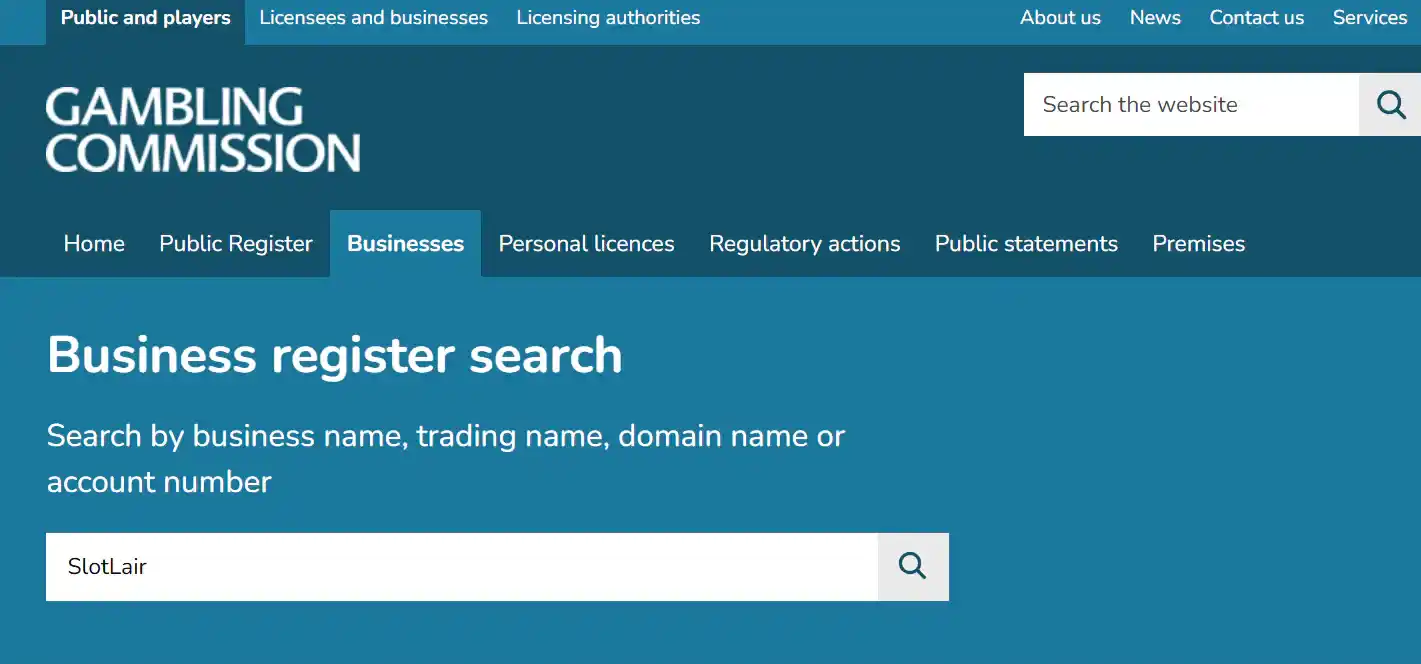
The required image is a real capture of the current UK Gambling Commission business register used for the SlotLair check.
The verified SlotLair licence position for UK readers
The current check of the UK Gambling Commission’s public business register did not verify SlotLair as a licensed business, trading name or domain. The register itself states that it can be searched by business name, trading name, domain name or account number and was last updated on 11 September 2026. The precise conclusion is that no UKGC licence has been verified for SlotLair. It does not turn a failed match into a claim that no licence could possibly exist under every unknown corporate alias.
That distinction matters because the UKGC’s remote-sector guidance is explicit about Great Britain. An operator providing remote gambling facilities to consumers in Great Britain needs a Commission licence, including when the business is based outside Great Britain. For an online casino, the relevant category is a remote casino operating licence.
Practical reading: SlotLair may present an English site, GBP cashier options and an account flow that UK users can reach, but those product and access signals are not substitutes for a UKGC register entry.
Great Britain and Northern Ireland are not the same licensing question
“UK” is convenient shorthand for an audience, but the legal framework is not one uniform online-gambling licensing system across all four nations. The UK Gambling Commission regulates commercial gambling in Great Britain – England, Scotland and Wales – under the Gambling Act 2005 framework. Its current guidance says remote operators serving consumers in Great Britain require a UKGC licence.
Northern Ireland has a separate statutory framework. The Department for Communities states that gambling there is regulated under the Betting, Gaming, Lotteries and Amusements (Northern Ireland) Order 1985 as amended by the 2022 Act. That framework has its own history and does not make UKGC licensing language automatically transferable to Northern Ireland.
For this reason, a statement such as “SlotLair is licensed in the UK” would be inaccurate on the available evidence, while “SlotLair is illegal in the UK” would also overreach the evidence. The useful question is narrower: what licence can be verified, which local regime applies to the reader, and which protections follow from that status?
What the Costa Rica jurisdiction report does and does not prove
Multiple independent casino-industry sources identify Costa Rica as SlotLair’s jurisdiction. SlotCatalog lists Costa Rica in its licence field, while CasinoJager describes SlotLair as a Costa Rican online casino and identifies Amo Global SRL. A further review also reports Costa Rica but conflicts on the operator name. Taken together, the repeated jurisdiction references support describing Costa Rica as SlotLair’s reported operating jurisdiction, while the conflicting operator names mean no single parent company can be presented as settled fact.
There is also no verified licence number in the current source set. That is important because a jurisdiction label and a regulator-verifiable licence number are not interchangeable. Readers should not infer a specific licence certificate, expiry date, complaints scheme or statutory protection simply because several review sources use the same country label.
| Question | Current evidence | What you can reasonably conclude |
|---|---|---|
| UKGC licence? | No SlotLair UKGC licence verified in the current register check | Do not attribute UKGC licence protections to SlotLair |
| Great Britain rule? | UKGC says remote operators serving GB consumers need a licence | GB authorisation depends on a UKGC licence, not merely site access |
| Northern Ireland? | Separate 1985 Order framework as amended | Do not treat GB rules as identical across Northern Ireland |
| Other jurisdiction? | Multiple independent sources identify Costa Rica | Costa Rica can be reported as the jurisdiction signal, without inventing a licence number |
Why UKGC status changes the protection question
UKGC licensing is more than a logo. Commission-licensed operators are subject to licence conditions, compliance supervision and the rules attached to the British licensing regime. If a SlotLair UKGC entry is not verified, this site will not imply that those protections apply to SlotLair merely because the website can be accessed or because GBP appears in its cashier.
The same caution applies to GAMSTOP. GAMSTOP describes its online self-exclusion service as covering participating gambling websites and apps licensed in Great Britain. Without a verified UKGC licence for SlotLair, it would be misleading to tell readers that SlotLair is covered by GAMSTOP as a licensed GB operator. The absence of that claim is about evidence and scope, not a statement about whether every responsible-gambling tool on the SlotLair site works or does not work.
Likewise, access to a UKGC-linked alternative dispute resolution route should not be assumed. Complaint handling, account closure and support can still exist as operator processes, but they should not be presented as UKGC consumer-protection coverage without the required regulatory evidence.
Licence status is separate from payment, game and account facts
Licensing uncertainty should not be used to cast doubt on unrelated product facts. The current official SlotLair payments page can independently show which deposit or withdrawal methods are listed. The current Terms can independently show account rules and KYC clauses. The games lobby can independently show categories and providers. Those are product facts with their own evidence.
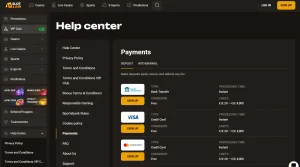
For example, the official payments material lists GBP withdrawals through Visa, Mastercard and bank transfer, while the Terms allow identity verification before a payout. Those statements remain about SlotLair’s published cashier and account rules. They do not become proof of UKGC authorisation, and the lack of a verified UKGC licence does not by itself make those published product details false.
If your immediate concern is moving money rather than regulation, use the SlotLair withdrawals guide for current cashier times, limits and the difference between payment-method processing and account-level verification.
Objective trust signals worth checking before a deposit
Licensing is the strongest regulatory signal, but it is not the only piece of evidence a player can inspect. Several practical controls are visible in SlotLair’s public materials: published Terms, a payments table, KYC language, stated support routes and public promotional conditions. These do not replace a licence, but they help you assess how much of the operating model is documented before you commit money.
- Read the current Terms: check the restricted-country clause, one-account rule, payment ownership requirements and withdrawal conditions.
- Open the cashier information: confirm that the method you intend to use is listed for the direction you need, especially withdrawals rather than deposits alone.
- Prepare for KYC: SlotLair can require identity checks before payout, so do not assume a successful deposit means withdrawal verification is complete.
- Test support before depositing: the official support materials state 24/7 availability by email and Intercom/live chat. A simple pre-deposit question can show whether the route is usable for you.
- Check current promotion terms: do not rely on a banner or an old review when a bonus changes. Current SlotLair promotional pages have shown conflicting welcome-package figures, so the specific terms need checking at claim time.
These checks turn “trust” into observable questions rather than a badge. They also create a record of what you saw before depositing, which can be useful if you later need to compare a transaction or account decision against the operator’s published wording.
What a UK player should not infer from site access
A working registration form, GBP currency selection, English support and a visible casino lobby can demonstrate that a product is accessible and localised. They do not demonstrate local regulatory authorisation. Those dimensions need to stay separate because a single yes/no availability label would hide the difference.
The same principle applies in reverse. A missing UKGC register verification is not evidence that SlotLair has no games, no payment methods or no support. It is evidence about one specific regulatory question. If you are deciding whether to create an account, the SlotLair registration page covers the operational setup; licensing and consumer protections are covered separately here.
How the reputation page complements this licence check
Regulator evidence and user-review evidence answer different questions. The register tells you about licensing status. Review platforms can show patterns of user satisfaction or frustration, but individual reports are not proof that every account will have the same outcome. That is why this site’s SlotLair reputation page treats complaints as a separate evidence layer and compares them with current official rules.
That separation helps avoid two weak shortcuts: assuming a licence automatically guarantees a frictionless individual experience, or assuming a complaint automatically proves a legal or financial allegation. A better decision combines the regulatory status, the operator’s current published rules, the payment and KYC mechanics, and recent reputation signals.
How to verify the status yourself
For Great Britain, start with the UK Gambling Commission’s public business register. Search not only the brand name but also any operator name or domain shown in current terms or account correspondence. The register itself supports business, trading-name and domain searches. If you find a result, open the business record and confirm the licence is active and that the relevant trading name or domain is actually attached to it.
Do not use a casino-review badge as a substitute for that register check. For Northern Ireland, use the Department for Communities’ current gambling material to understand the separate local framework. If a casino later publishes a new licence statement, verify the regulator and number rather than carrying forward an old review claim.
What SlotLair’s licensing position means for UK players
The practical conclusion is specific rather than binary. No UKGC licence has been verified for SlotLair, while Great Britain requires a UKGC licence for remote gambling supplied to consumers there. Independent sources identify Costa Rica as SlotLair’s jurisdiction, but no current licence number is verified and the operator identity is not settled across sources. Northern Ireland sits under a separate gambling framework and should not be described as if UKGC rules automatically cover it.
For a UK reader, that means site access and GBP support should be assessed separately from regulatory protection. Before depositing, verify the current register status, understand the published withdrawal and KYC rules, and look at recent complaint patterns without treating anecdotes as legal findings. The full SlotLair review brings those product layers together, while the licensing analysis remains focused on regulatory status and protections.
Material created by the team SlotLair