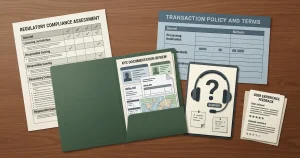


The guide separates postponed identity checks from claims of no checks, and explains how licensing, payment methods and limits affect withdrawals.
What “No Verification” Really Means at UK Casinos
“No verification” can describe two very different things: a casino that has not asked for documents yet, or a claim that it will not check your identity at all. Those are not equivalent. A delayed check is still a check, and a site’s marketing label does not establish that you can withdraw without proving who you are.
For customers in Great Britain, the regulatory baseline is clear: online gambling businesses must verify age and identity before letting a customer gamble. A no-KYC label does not cancel that requirement for a business serving the market under UK rules. Treat the phrase as a description of how an operator presents its process, not as proof that identity checks do not apply.
The distinction matters most when you move from registering to trying to access winnings. A site may let you create an account and begin using it before asking for documents, then request verification before processing your first withdrawal. In that case, checks have been postponed, not removed. A withdrawal request can be the point at which the promise of “no ID” meets the operator’s actual account requirements.
If you’re looking for a UK casino withdrawal without ID checks, remember that payout speed alone does not tell you whether verification may be required. Use the listed payout estimate as one point of reference and check the operator’s terms before depositing.
1. Revery Play
Payout speed: 1-3 business days Revery Play lists a payout speed of 1–3 business days. This gives you an estimate of the withdrawal timeframe, but does not confirm whether ID verification is required.
2. Zombillion
Payout speed: 1-3 business days Zombillion lists a payout speed of 1–3 business days. If you’re considering it, check its terms for verification requirements as well as withdrawal timing.
3. SpinFormula
Payout speed: 1-3 business days SpinFormula lists a payout speed of 1–3 business days. That timing is the available detail here; it does not establish whether you can withdraw without verification.
4. Jetsetspins
Payout speed: 1-3 business days Jetsetspins lists a payout speed of 1–3 business days. You’ll need to check its terms separately to understand any ID checks that may apply.
5. EvoSpin
Payout speed: 1-3 business days EvoSpin lists a payout speed of 1–3 business days. Treat this as a withdrawal-time estimate, not a guarantee that no verification will be requested.
6. NightWin
Payout speed: 1-3 business days NightWin lists a payout speed of 1–3 business days. The available information does not specify its verification policy, so check the terms before playing.
7. Chanze
Payout speed: 1-3 business days Chanze lists a payout speed of 1–3 business days. This offers a timeframe to consider, but you’ll need other information to establish whether ID checks apply.
8. Britsino
Payout speed: 1-3 business days Britsino lists a payout speed of 1–3 business days. Check its withdrawal terms for verification details; the listed timing alone does not answer that question.
9. WinBeast
Payout speed: 1-3 business days WinBeast lists a payout speed of 1–3 business days. You can use that as a timing reference, while checking separately whether verification is required.
10. NightLuck
Payout speed: 1-3 business days NightLuck lists a payout speed of 1–3 business days. No verification details are provided here, so review its terms before relying on a no-ID withdrawal.
Read the claim as a timing claim
When you see a no-ID casino claim, separate it into two questions:
- When might the site check you? The check could happen before you gamble, later in the account process, or when you request a withdrawal.
- Will it ask you to verify your identity at all? A lack of an early request does not answer this.
That simple distinction is more useful than taking “no verification” literally. It also helps explain why two people can describe the same casino differently: one may have completed account activity without being asked for documents, while another may have reached a withdrawal stage and been asked to provide them.
For UK-licensed casinos, verification is generally part of the process at some stage, and online gambling businesses in Great Britain must check age and identity before gambling begins. The timing can differ between operators and account situations, but the obligation is not the same as a voluntary feature that can be switched off. A site that advertises an absent check should not be assumed to operate outside that requirement.
Some offshore casinos position themselves as no-KYC because they may delay fuller checks until a first cashout. That can make registration feel less demanding, but it does not mean a withdrawal will be released without scrutiny. Offshore operators typically require identity verification before processing the first withdrawal. The difference is often when a check occurs, rather than whether it occurs.
Online Casinos With No Sister Sites in the UK
What a later request can involve
A request for verification may extend beyond a single identity document. A specialist review describes possible checks involving proof of identity, address and contact details, as well as information about the source of funds. The exact request depends on the operator’s process; the important point is that a “no-KYC” description does not guarantee that none of these details will be requested.
If documents are requested, read the instruction carefully and check that the request comes through the casino’s official account or support channel. Do not assume that a payment will be processed simply because the account was previously usable. Nor should you interpret a document request as proof that the original marketing claim meant checks would never happen. It may have meant that checks were not made at sign-up.
This is where the wording on a site can mislead without being complicated. “No verification” sounds like a permanent exemption. “Verification may be delayed” describes a process. Unless the terms clearly explain when documents can be requested, the safer reading is that an early request may be absent while a later one remains possible.
Before depositing, look for the account and withdrawal terms that explain verification, and consider whether you are comfortable providing documents if asked. If the terms are unclear, the marketing phrase alone cannot settle the question. A convenient registration is not the same thing as a verified route to withdrawal.
Attention: A "no-KYC" label does not guarantee that identity checks are absent; it often means they are simply postponed until you request a withdrawal.
The useful comparison is therefore not simply “ID requested” versus “ID not requested.” It is whether the operator explains its checks, when they may occur, and what could be needed before a withdrawal is processed. A no-verification withdrawal casino may offer less friction at the start, but that does not establish that the cashout stage will be document-free.
In short: delayed is not absent. A no-KYC claim should never be treated as a promise that you can gamble or collect winnings without identity checks.
UK-Licensed and Offshore Casinos: The Difference Is Often Timing
The phrase “no verification” can make two different operating models sound alike. One is a UK-licensed casino that asks for identity information early; the other is a Non UK registered casino that may postpone a fuller check until you request a withdrawal. That difference in timing can affect how the first stage of your account feels, but it does not mean that the second type has no identity checks.
At a UK-licensed casino, identity checks are generally part of the process before you start gambling. UK Gambling Commission rules require operators to establish a customer’s age and identity before gambling takes place. In practice, UK-licensed sites often complete full KYC before accepting a first deposit. If you are comparing a casino with no ID verification against a regulated UK site, the important distinction is therefore not simply whether documents are requested. It is when the operator expects to establish who you are.
£1 Minimum Deposit Casinos in the UK: What to Check
Offshore sites may present a different sequence. They commonly postpone a full identity review until a customer’s first cashout, rather than completing it before the first deposit. That can make registration and initial play appear to involve fewer checks. But an online casino with no verification at sign-up is not necessarily a casino with no verification at all. The withdrawal point may be where the operator asks you to provide information it did not request earlier.
This is why a search for an online casino with no verification withdrawal can lead to an offer that sounds more definite than its terms. “No-KYC” may describe the initial account process, a marketing claim, or a particular stage of play. It does not establish that the operator will release money without confirming identity. Non-GamStop casinos and other offshore sites can still ask for documents before approving a withdrawal; the timing is not the same as an exemption.
The licence changes the context
A UK Gambling Commission licence is not a label for a particular payment or sign-up feature. It identifies an operator within the UK regulatory system. Remote gambling businesses offering services to people in Great Britain are required to hold the relevant UKGC licence, wherever the business itself is based. A site operating under a foreign licence does not become UK-licensed simply because people in Britain can reach its website.
Remote gambling businesses offering services to people in Great Britain are required to hold the relevant UK Gambling Commission licence, regardless of where the business is based.
For a UK reader, this distinction matters when interpreting claims about online casinos with no ID verification. A foreign licence means the casino is governed by an overseas regulator rather than the UK Gambling Commission. It does not make the casino a UK-regulated operator, and a claimed delay in identity checks does not alter that status. Conversely, early KYC at a UK-licensed casino is not evidence that its checks are unusually intrusive; it reflects the point at which the operator must establish age and identity.
The rules also distinguish the operator’s obligations from a player’s circumstances. A UK resident may play at a casino licensed abroad where the operator is not unlawfully targeting the British market. That conditional point should not be stretched into a general claim that every offshore casino is authorised to serve UK customers. Nor does access to a site turn its foreign licence into a UKGC licence. The legal position depends on the operator and how it offers its service.
Compare the sequence, not the slogan
A useful comparison is to write down the point at which each site says it will verify you:
| Site type | Common point for full checks |
|---|---|
| UK-licensed casino | Often before the first deposit |
| Offshore casino | Often before the first withdrawal |
These are common patterns, not promises about every account. A UK-licensed operator may still need to resolve an individual check later, and an offshore site may request information earlier than its typical process suggests. The table describes timing, not certainty.
That distinction is especially relevant if you are looking for a live casino with no verification or a casino with no ID verification in the UK. Live games do not create a separate identity rule, and the phrase “in the UK” does not make a foreign operator UK-licensed. The format of the game is less important here than the operator’s licence and the stage at which it carries out checks.
Before treating a no-KYC description as a practical advantage, read the site’s terms for the circumstances in which it may request documents. Consider whether you are comfortable with verification happening before you deposit or potentially when you seek to withdraw. A claim that sounds attractive at registration may offer little certainty about the later account review. Read the wording carefully.
There is no single “best” no-ID option on timing alone. If your priority is an established UK regulatory framework, early verification is part of the comparison. If your priority is a later check, an offshore site may appear less demanding at the start, but the foreign licence and withdrawal-stage review remain relevant. The better fit depends on which trade-off you are willing to accept—not on the words “no verification” in a banner.
Instant Withdrawals Have Two Clocks
An “instant withdrawal” claim can describe only part of the journey. To judge what it means for your money, separate the process into two stages: the casino’s approval of the request and the payment provider’s settlement of the approved withdrawal. A quick result at one stage does not establish how quickly the other will finish.
Clock one: casino approval
After you request a withdrawal, the casino has to decide whether to approve it. Until that decision is made, the money has not moved into the payment stage. A site may describe its withdrawals as instant while the request is still waiting for the casino to review it.
How casino approval works
After you request a withdrawal, the casino must decide whether to approve it. Until this decision is made, the money has not yet moved to the payment provider for settlement.
That distinction matters particularly when a site presents itself as a no-KYC casino. The label does not prove that a withdrawal will be approved without checks. Most non-GamStop casinos still ask for identity documents before approving a withdrawal, despite using no-KYC language in their marketing. If documents are requested, the approval clock has not finished simply because you submitted the cashout request.
The useful question is therefore not just, “How fast are withdrawals?” It is, “When does the casino approve a withdrawal, and what must happen before approval?” Those are separate points. A published claim about speed is difficult to interpret if it does not make clear whether it refers to the casino’s decision, the payment provider’s work, or both.
Clock two: payment settlement
Once the casino approves a withdrawal, the payment provider must settle it. This is the second clock. Approval means the casino has authorised the payment; it does not, on its own, tell you when the payment will be completed.
A fast approval claim can therefore coexist with a longer settlement stage. Conversely, a payment method’s ability to handle a transfer quickly does not establish that the casino will approve the request just as quickly. Treating these as one event obscures where a delay is occurring.
Quick Withdrawal Casinos in the UK: Payouts Explained
When comparing claims, look for wording that identifies the stage. “Processed” can be ambiguous: it may refer to the casino accepting the request, or to the payment being sent onward. “Paid” can also be used loosely. What matters is whether the casino has approved the withdrawal and whether the provider has completed settlement. If the wording does not distinguish those events, it does not give you a clear end-to-end timeframe.
A practical way to read speed claims
Use a simple comparison:
| Point to establish | What it tells you |
|---|---|
| When the casino approves the request | How long the casino’s stage may take |
| What can prevent approval | Whether the request might pause before payment |
| When the provider’s stage begins | Whether the quoted speed starts before or after approval |
| What the stated completion means | Whether it describes approval or settled payment |
This is not paperwork for its own sake. It stops a quick-sounding label from answering a different question than the one you care about. If your priority is access to funds, the relevant measure is the whole path from request to settlement, not a single stage described as instant.
For a no-ID verification withdrawal casino site, the same distinction applies. A no-KYC claim is not a promise that the casino will release every withdrawal without asking for documents, and an instant label does not remove the approval stage. If the casino asks for identity documents, the request still needs approval before payment settlement can complete. The two clocks remain separate.
The comparison is clearer when a site explains what “instant” refers to and where the payment stands after casino approval. If those details are not stated, avoid treating the claim as a complete account of withdrawal speed. It may describe only one part of the process.
Do
- Track your withdrawal status in order: request, approval, then settlement
- Distinguish between the casino’s decision and the provider’s payment
Don’t
- Assume an “instant” label covers the entire process from request to funds arrival
- Confuse a received request with an approved payment
The key is to follow the status in order: request submitted, casino approval, then payment settlement. Each status answers a different question. A request can be received without being approved; an approved withdrawal can still be awaiting settlement. That is why the shortest advertised stage is not necessarily the time you should expect from request to completed payment.
No single word can cover both clocks. “Instant” may sound conclusive, but without knowing which stage it describes, it is only a partial measure. The winner depends on your criterion: if you care about the casino’s decision, compare approval; if you care about when funds arrive, consider the full process through settlement. Two clocks. One withdrawal.
Bonuses, Deposits and the GamStop Difference
A “no-deposit bonus” describes how an offer is funded: it does not require an initial cash deposit. It does not, by itself, tell you whether identity checks apply, whether the bonus can be withdrawn, or what conditions govern its use. The same caution applies to claims of a no-verification casino bonus. The label is not a promise that you can claim or cash out an offer without checks.
Read the offer terms before treating a bonus as playable money. Look for eligibility rules, any playthrough conditions, withdrawal restrictions and the operator’s verification policy. A bonus described as “no wagering” is not necessarily free of other conditions. If terms are unclear, do not assume the most favourable interpretation.
The key comparison is between the offer and the protections attached to the site. A generous-looking promotion does not settle whether the operator is connected to the UK’s self-exclusion scheme. That is a separate question, and it matters more than the bonus label if you have chosen to exclude yourself from gambling.
What GamStop connection means
UK-licensed operators must participate in GamStop, the national online gambling self-exclusion scheme. A site outside GamStop does not hold a UK Gambling Commission licence; it operates under an overseas licence and is not connected to that database. Offshore operators are not required to integrate with GamStop, so an exclusion registered through the scheme does not cover them.
Casino Not on GamStop: Understanding Instant Withdrawals
This is not a bonus-shopping distinction. If you have self-excluded through GamStop, looking for a non-GamStop casino to continue playing would undermine that choice. A bonus does not change the practical effect of the exclusion, and a site’s lack of connection is not a safeguard or a substitute for support.
Compare the terms, not the headline
For a no-deposit offer, separate three questions:
| What to check | Why it matters |
|---|---|
| Is a deposit required to claim it? | The headline may describe the initial offer, not every later step. |
| What conditions apply to winnings? | A bonus balance and withdrawable cash are not necessarily the same thing. |
| Is the site connected to GamStop? | This determines whether the national self-exclusion scheme applies there. |
A no-deposit bonus can still come with conditions. A no-ID claim does not establish that checks will never be requested. And GamStop status cannot be inferred from promotional wording: it follows the operator’s licensing and scheme connection.
If you are comparing offers, the useful criterion is not the largest headline bonus. It is whether the terms are clear and whether the site’s status fits your circumstances. If you have self-excluded, do not use an offshore offer to get around that decision. The bonus is the smaller issue.
Fast Cashouts Still Depend on Checks and Limits
A fast-cashout claim describes a possible processing experience, not a promise that identity checks will be skipped. An offshore casino can leave full document checks until later while using electronic identity verification (eKYC) behind the scenes. That means a registration form may feel brief, yet details can still be checked automatically when you request a withdrawal.
Attention: Electronic identity verification (eKYC) may occur automatically behind the scenes, meaning a brief registration does not equal a lack of verification.
If an automated check cannot confirm the information provided, the casino may ask you for documents before approving payment. A no-KYC label therefore does not establish that you can withdraw without verification. It may describe the sign-up process, or the point at which checks are made, rather than the requirements for releasing winnings. “Anonymous” is not a useful substitute for reading those requirements.
The practical test is what the withdrawal terms say about verification, not how little information the registration page requests. Check which documents may be needed, how the casino handles a failed or incomplete electronic check, and whether the account details you provide must match your payment details. If those conditions are unclear, a short sign-up process tells you little about how straightforward a cashout will be.
The limit can matter more than the speed
Withdrawal caps create a separate constraint. A casino may approve a payment promptly but still restrict how much you can withdraw within a stated period. When a win exceeds that allowance, access to the full balance can be spread over time. A quick first payment does not remove the cap.
A specialist casino review has reported monthly withdrawal caps at offshore casinos. Treat that as a term to verify for the individual operator, not as a fixed rule for every site. Look for the relevant limit in the withdrawal terms and check whether it applies to all payment methods or to particular account types. The amount, period and any stated exceptions matter more than a general “fast payouts” badge.
For a larger win, compare the cap with the balance you may want to withdraw, then consider whether the terms allow the remaining balance to be paid later. Also check whether the casino can request verification while processing those payments. A cap and an identity check can affect the same withdrawal, but they are different conditions: one restricts the amount released; the other may hold approval until information is confirmed.
The useful comparison is not simply “fast” versus “slow”. It is whether the casino can verify your account smoothly and whether its withdrawal rules let you access the amount you expect. Fast on paper; limited in practice.
Some offshore casinos may apply monthly withdrawal caps, which can limit how quickly you can access a large win even if the payment is processed quickly.
Real-Money Play: Check the Cost of Moving Funds
A card accepted by a casino does not tell you whether the payment will go through cleanly, what it will cost, or whether the operator is authorised to serve customers in Great Britain. Those are separate checks. For real-money play, compare the deposit route, the cash-out route and any charges before you send funds.
UK-licensed operators have been barred from accepting credit-card gambling payments since April 2020. Non-UK-registered casinos may still accept Visa and Mastercard for deposits, and some also support card withdrawals. That availability does not make a site UK-licensed: operators offering remote gambling to customers in Great Britain must hold the relevant UK Gambling Commission licence. Before depositing, verify the licence number on the regulator’s public register.
Fees can change the comparison. A specialist review has reported offshore casino credit-card deposit charges in the 2%–5% range; treat that as a reported cost, not a fixed tariff for every operator or card. Check the casino’s cashier and your card provider’s terms for the actual charge. A deposit that looks straightforward at checkout may cost more once fees are included.
Bank response is another variable. A British bank may flag, delay, decline or block a payment to an offshore gambling operator. That can interrupt a deposit or complicate a transfer, regardless of whether the casino advertises anonymous access. Some banks may apply their own controls to these transactions, so acceptance at the casino’s end is not a promise that your bank will process them.
£2 Minimum Deposit Casinos in the UK: What to Know
For a practical comparison, record whether the method supports deposits, withdrawals, or both; the fees shown by the casino and your bank; and what happens if a payment is declined. Keep the payment route and account details consistent with the operator’s stated requirements. The least costly option on deposit can still be a poor fit if it does not provide a workable way to receive funds.
“No ID” marketing does not make card payments anonymous or remove financial checks. Card providers and banks still process the transaction, and a casino’s willingness to accept a card says nothing by itself about the information it may request later. Compare cost and access, not just the deposit button.
Bitcoin Withdrawals: Speed Is Not the Same as Anonymity
Bitcoin can be a withdrawal option at some offshore casinos, but its presence does not make a casino a no-KYC service. A site may let you deposit or request a payout in cryptocurrency and still ask for identity documents before releasing funds. “Bitcoin casino no verification” is therefore a claim to check against the withdrawal terms, not a reliable description of what happens when you cash out.
Timing claims also need careful reading. One specialist review puts cryptocurrency withdrawals at serious offshore operators at one to six hours. Another specialist review says operators that accept cryptocurrency can process withdrawals in minutes. These are reported timings, not a guarantee for every Bitcoin payment or every account. A casino’s stated processing time may also depend on its own approval, so distinguish a published estimate from a confirmed payout to your wallet.
Using cryptocurrency does not make gambling activity invisible to HMRC, nor does it exempt you from identity checks if the operator requests them.
Quick is not anonymous. Bitcoin transactions are recorded on a public blockchain, and using cryptocurrency does not make gambling activity invisible to HMRC. Nor does a crypto deposit prevent an operator from asking who owns the account or where funds came from. If a casino markets itself as a Bitcoin casino with no ID checks, read the withdrawal conditions for circumstances in which verification can be requested. The marketing label does not settle the question.
Before choosing this route, check whether the casino supports Bitcoin for both deposits and withdrawals, and whether its rules require the same method for cashing out. Confirm the wallet details carefully: a transaction sent to an incorrect address may not be recoverable. Also check the casino’s licence status. A cryptocurrency option does not change the regulatory position of an operator serving British customers.
The useful comparison is not simply “Bitcoin or bank transfer”. It is whether the operator’s withdrawal rules, verification process and stated timing suit you. A fast crypto estimate may matter if speed is your priority; clear conditions matter more if you want to know what could delay approval. Neither removes the need to verify your identity when asked. Speed is one criterion. Privacy is another—and Bitcoin does not provide anonymity.
Crypto Casinos and Withdrawal Caps
A crypto casino marketed as no-KYC can still place a ceiling on how much you may withdraw over a set period. The label describes a claim about verification, not how quickly you can access a large balance. Even where cryptocurrency is accepted, a withdrawal cap may matter more than the payment method if a win exceeds what the casino allows you to cash out at once.
£3 Minimum Deposit Casinos in the UK: How It Works
A specialist review reports that some offshore casinos set daily, weekly or monthly withdrawal limits, which can stretch the time needed to receive a large win. Treat that as a term to verify for the individual site, not a rule that applies to every crypto casino. Check the casino’s published withdrawal policy for the cap, the period it covers and whether the limit differs by account or payment method. If the terms are unclear, ask support for a written explanation before depositing.
The comparison is straightforward: a higher cap is more favourable if your priority is access to a large balance; a lower cap can make the advertised no-KYC angle less useful in practice. A limit may divide a cashout into separate requests, so the headline claim that withdrawals are available does not tell you how much you can take out at once.
Nor does “no verification” mean identity checks are impossible. A no-KYC claim is not a promise that every withdrawal will be released without questions, and it does not remove the need to read the operator’s terms. Crypto changes the payment route; it does not settle the casino’s own withdrawal rules.
For a crypto casino no-KYC comparison, put the withdrawal cap beside the verification wording. If the cap is restrictive or hard to find, that is a meaningful drawback—not a small-print detail. No magic shortcut.
Pay-by-Mobile Deposits: Know What They Do Not Cover
A pay-by-mobile option can make funding an offshore casino look simple: the deposit is charged through your phone account rather than sent by card or cryptocurrency. But the payment route has a narrow job. It does not, by itself, establish that a casino offers no-KYC withdrawals or that winnings can be returned to your phone bill.
Many pay-by-mobile services at offshore casinos, such as Boku, are deposit-only and cannot be used to withdraw winnings.
A specialist review describes Boku and similar services at offshore casinos as deposit-only. Treat that as a point to verify against the casino’s current cashier terms, not as a promise that every operator handles mobile payments the same way. Before depositing, check whether the method is accepted only for adding funds and which withdrawal routes are available instead.
That distinction matters if you are comparing pay-by-mobile casinos marketed as requiring no verification. A deposit method is not evidence that identity checks will be waived, nor does it tell you how a withdrawal will be processed. Your phone account may cover the money going in; it may not provide a route for money coming out.
Keep the two questions separate: can you deposit by phone, and how can you withdraw winnings? If the cashier information does not clearly answer the second, do not assume the deposit option answers it for you. Different jobs.
Choosing a No-ID Casino by the Trade-Off That Matters to You
A no-KYC label does not settle whether a casino will ask for documents, accept your payment method or let you withdraw a large balance on your preferred schedule. Choose by the constraint you can live with—not by the strongest promise in an advert.
Casino Finder: UK Deposit and Payout Options
| Your priority | What to compare before depositing |
|---|---|
| Fewer checks at sign-up | When identity checks begin and what may trigger a request |
| Payment access | Whether your bank and the casino support the same payment route |
| Access to a large win | The withdrawal limits and how they apply over time |
If verification timing matters most, look for clear terms explaining when documents may be requested and what the operator can ask you to provide. A site that postpones checks is not necessarily a site that removes them. You should be comfortable with the possibility of a withdrawal being held while a check is completed. “Anonymous” and “no ID” are not reliable substitutes for knowing the operator’s process.
If payment access is your main criterion, check the available routes and consider whether your bank may block a transaction. A specialist review has reported that some UK banks block payments to offshore gambling sites by default; treat that as a possible obstacle, not a rule applying to every bank. The UK Gambling Commission can also block transactions to operators that lack the required licence. A payment method shown on a cashier page does not guarantee that your bank will approve its use.
The legal distinction matters when comparing sites. Remote operators offering gambling to customers in Great Britain must hold a UK Gambling Commission licence. Before depositing, verify the licence number against the issuing regulator’s public register. A foreign licence is not a UKGC licence, and a claim about being accessible from the UK does not establish that an operator is authorised to target the British market.
If your priority is access to a larger win, read the withdrawal terms before play. Daily, weekly or monthly caps can affect how quickly a balance can be paid out, even when the operator approves a request. Compare the limits with the amount you would be willing to leave on the account, rather than assuming that a successful win can be withdrawn in one payment.
For real-money play, the practical choice is therefore a balance: verification timing, usable payment routes and withdrawal conditions. Decide which matters most, then check the relevant terms and licence status before funding the account. The “best” no-ID casino is not a universal winner; it is the option whose constraints you understand and accept. If any material condition is unclear, that uncertainty is itself a cost.
Do UK banks block deposits to non-GamStop casinos?
Yes, some UK banks may decline, flag, delay or block payments to offshore gambling sites. The UK Gambling Commission can also block transactions to unlicensed operators.
Is it legal for UK players to use non-UK-registered casinos?
Yes, UK residents can legally play at casinos licensed outside the UK, provided the operator is not illegally targeting the UK market. These casinos are not covered by GamStop.
Do non-UK-registered casinos accept credit cards?
Yes, offshore casinos routinely accept Visa and Mastercard, although deposits may incur fees of 2% to 5%. Credit card gambling has been banned at UK-licensed operators since April 2020.
Can I withdraw winnings without KYC verification?
Usually not: offshore casinos typically require identity verification before processing a first withdrawal, even if they advertise no-KYC registration. Checks may also cover your address, contact details or source of funds.
How long does it take to get the money?
It depends on the withdrawal method and the casino’s approval process: cryptocurrency withdrawals can take minutes to six hours, while Skrill and Neteller withdrawals at established operators typically clear within 24 hours. Bank-transfer fees and withdrawal limits can also affect access to your money.
Material created by the team SlotLair