
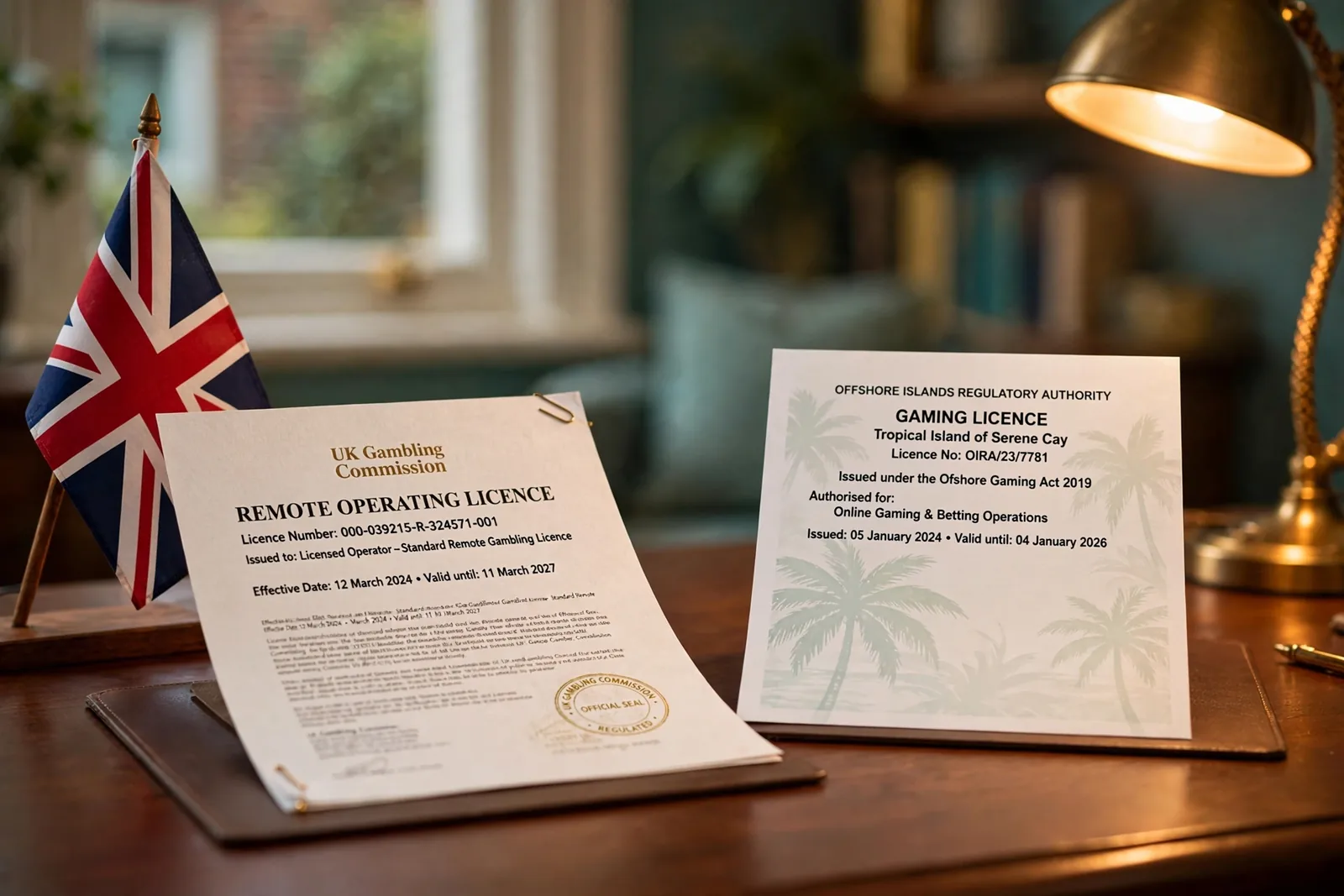
A licence from another jurisdiction may authorise an operator there, but it is not a UK Gambling Commission licence.
How UKGC Regulation Differs from an Offshore Licence
The key distinction is whose regulatory framework applies to the casino. A UKGC-regulated online casino holds a licence from the UK Gambling Commission for serving customers in Great Britain. An offshore licence is issued by a regulator elsewhere. It may authorise an operator under that jurisdiction’s rules, but it is not a UKGC licence.
The operator’s physical location does not decide which licence is required. A company based abroad still needs a UK Gambling Commission licence if it serves customers in Great Britain. Conversely, having a licence from another jurisdiction does not turn that authorisation into UKGC oversight. The relevant test is the market the operator serves, not the address on its corporate paperwork.
This distinction helps make sense of labels such as “regulated” and “licensed”. They are incomplete unless you know which authority issued the licence and what market it covers. A casino may be regulated somewhere without being regulated by the UKGC. For a reader comparing online casinos, “licensed” alone is therefore not enough to identify the standard of oversight that applies.
| Point to distinguish | UKGC-regulated casino | Casino with an overseas licence |
|---|---|---|
| Licensing authority | UK Gambling Commission | A regulator in another jurisdiction |
| What the licence signifies | UKGC oversight for the operator serving Great Britain | Authorisation under the issuing jurisdiction’s framework |
| Does it establish UKGC oversight? | Yes | No |
The table describes the source of oversight, not a ranking of every regulator’s rules. Foreign licensing systems are not identical, and the word “offshore” does not identify a single regulator or one shared set of conditions. You need to identify the actual issuing authority before deciding what “regulated” means in a particular case.
What “UK regulated” means in practice
When people ask which online casinos are licensed and regulated in the UK, the decisive point is whether the operator holds the relevant UK Gambling Commission licence for serving customers in Great Britain. A company’s UK office, branding, or use of familiar payment options does not answer that question. Nor does a foreign licence, by itself.
The same distinction applies to phrases such as “regulated casino” or “licensed and regulated online casino”. These descriptions can sound reassuring while leaving out the essential detail: regulated by whom? If the answer is a regulator outside the UK, the casino may be regulated under that authority, but it is not a UKGC-regulated casino.
A clear comparison starts with the licence issuer. Then consider the market the authorisation covers. Those two details prevent a common category error: treating any licence as if it were interchangeable with a UKGC licence. It is not.
Why the issuing authority matters
Regulation is not a general badge that travels with an operator from one country to another. Each licence belongs to a particular regulatory system. A UKGC licence signals oversight by the UK Gambling Commission; an overseas licence signals oversight by the authority that issued it. The latter may be meaningful within its own framework, but it does not establish UKGC supervision.
Non-Gamban Casinos in the UK: What Status Means
That is why “online casinos regulated outside the UK” is a more precise description than simply “regulated casinos” when the regulator is based elsewhere. It tells you where the oversight comes from without implying that it is the same as British oversight. A licence can be real and still be the wrong answer to the question of whether an operator is UKGC-regulated.
The distinction also matters when comparing two casinos that both display licence information. One may hold a UKGC licence for the British market; another may rely on authorisation from a different jurisdiction. They may both use the word “licensed”, but the issuing authorities and the scope of their permissions differ. The comparison needs that criterion before any broader judgement is useful.
There is no single “best regulated” choice without a criterion. If your criterion is UKGC oversight, the relevant question is whether the operator holds the UK Gambling Commission licence required for serving Great Britain. If a casino instead relies on an overseas licence, that is a different regulatory arrangement—not a UKGC licence by another name.
In short, treat “licensed” as the beginning of the check, not the end. Identify the regulator, then distinguish a UKGC licence from authorisation issued elsewhere. That is the basic vocabulary needed to compare a UK regulated online casino with a casino regulated under a foreign framework. Different authority. Different remit.
Safety & Licensing for UK Online Casinos
What UK Law Says About Using an Offshore Casino
UK law draws an important distinction between a gambling operator’s conduct and an individual’s decision to use a site. The main legal question is whether a company is supplying gambling services to customers in Great Britain without the required authorisation. That question is not the same as whether a player who visits the site has committed an offence.
Under the Gambling Act 2005, operators serving customers in Great Britain must hold a licence from the UK Gambling Commission. The requirement applies regardless of where a company is based. A business does not avoid the rule simply by running its website, staff or servers from another country: if it supplies gambling services into the British market, its location does not remove the licensing obligation.
That is the operator-facing side of the law. A foreign licence may show that an authority elsewhere has authorised a business under its own rules, but it does not replace a UK Gambling Commission licence for an operator serving Great Britain. In other words, a site’s claim to be licensed abroad does not by itself establish that it is authorised to provide gambling services to customers here.
The player-facing position is different. UK law does not expressly make it an offence for a British citizen to use gambling services licensed overseas. Nor does a player commit a criminal offence simply by gambling on a site that lacks a UK licence. This distinction matters: the legal duties described above are directed at operators, not imposed on customers as a criminal penalty for placing a bet.
Non-GamStop European Casinos: UK Rules Explained
That does not mean an overseas-licensed site should be treated as a fully regulated UK casino. “Licensed offshore” and “licensed for the British market” describe different statuses. The first refers to permission granted by a foreign jurisdiction; the second means the operator holds the relevant UK Gambling Commission licence to serve customers in Great Britain. Treating the terms as interchangeable blurs the central legal distinction.
What “accepting UK players” can mean
A site may allow a person in Britain to register or attempt to play, but access does not establish that the operator is authorised to serve the British market. The fact that a website is reachable, or that it accepts a customer’s details, is not a substitute for the operator holding the required UK licence.
This is why phrases such as “non-UK-regulated casinos for UK players” need careful interpretation. They can describe overseas sites that British residents can access, but they do not mean those sites have permission under UK rules to supply gambling services in Great Britain. Availability and authorisation are separate questions.
It is also worth separating the operator’s legal position from the player’s. A company may be acting without the licence required for its British-facing services, while the individual using that site is not thereby committing a criminal offence under UK law. The law places the relevant licensing obligation on the operator. That is the dividing line.
What you need to check
If you are considering a foreign-licensed casino, do not assume that its overseas authorisation settles its status in Britain. First establish whether the operator holds a UK Gambling Commission licence for serving customers in Great Britain. A licence issued elsewhere answers a different question: whether the operator has permission under that jurisdiction’s framework.
Legal Responsibility
UK law places the licensing obligation on the operator, but you are responsible for checking the laws that apply to you and understanding the implications of using gambling services based outside the UK.
You are responsible for checking the laws that apply to you and understanding the implications of using gambling services based outside the UK. The legal position described here concerns Great Britain; local rules may differ depending on where you live. In particular, do not rely on a general statement about British law as a complete answer for every part of the UK or every individual circumstance.
The practical comparison is therefore not “licensed” versus “unlicensed” in the abstract. It is whether the operator has the authorisation required for the market it is serving, and what a foreign licence does—and does not—mean for a customer in Britain. An overseas licence is not a UK licence. And a player’s lack of criminal liability is not the same as UK authorisation for the site.
The Practical Risks of Playing Outside UKGC Oversight
A licence matters most when something goes wrong. At a UKGC-licensed casino, you have access to the UK’s regulated complaint and consumer-protection framework, including the Financial Ombudsman Service and mandatory responsible-gambling tools. At a non-UK-regulated casino, those routes and tools are not available on the same basis. That difference can affect how much control you have over your account, how a dispute is handled and what happens to money left with the operator.
The practical comparison is not simply “regulated” versus “unregulated”. It is about which protections apply to your account and what recourse remains if the operator delays a payment, changes its position or fails. A site licensed elsewhere may still process withdrawals, but an overseas licence does not give you the UKGC’s complaint route.
VPN-Friendly Casinos in the UK: What to Know
When a withdrawal takes longer than expected
Published accounts of withdrawal speeds at non-UK-regulated casinos disagree. One describes payments as taking as long as three or four weeks, with no regulatory clock requiring the operator to finish by a set point; another gives a range from 24 hours to five business days. Those accounts cannot be treated as a single reliable timetable. The key difference is that, outside UKGC oversight, you may have less effective recourse if the operator does not meet the timeframe it has presented.
A delay can also become an account issue. An operator may pause a payment while it checks identity or account activity. Verification is not automatically improper, but unclear requirements, repeated requests or an account being frozen while a withdrawal is pending can leave you unable to access funds when expected. Check the withdrawal and verification rules before depositing, and keep copies of the terms and any messages about your payment.
A specialist review has also described cases in which an offshore operator asked for notarised documents or a video call before releasing a withdrawal. This is a reported possibility, not a standard requirement across non-UK-regulated casinos. If such steps appear only after you request payment, they may make a dispute harder to resolve, particularly if the operator does not explain why the documents are needed or how to submit them.
A specialist review has also reported daily, weekly or monthly withdrawal caps at some offshore sites, which can mean receiving a large win in instalments. Treat that as an operator-specific condition to verify, not a general rule. A payment method that accepts a deposit does not, by itself, establish that the same route will work for withdrawals.
Withdrawal Risks
Outside UKGC oversight, you may face unpredictable payment timeframes, requests for notarised documents, or daily and monthly withdrawal caps.
Safeguards and control of your money
UKGC-licensed operators must provide responsible-gambling tools. Non-UK-regulated casinos may have less stringent requirements, so the tools available to you can be weaker or absent. Do not assume that a familiar-looking account page gives you the same controls as a UK regulated casino. If you need a particular way to limit or manage gambling, confirm directly that the operator offers it and how it works before you open an account.
Data protection is another point of comparison. Non-UK-regulated casinos may operate under less stringent data-protection rules than UKGC-licensed operators. That does not establish that every offshore site mishandles personal information; it means you should not assume that UKGC-level requirements apply. Consider what identity and payment information the site asks for, and whether its privacy terms explain how that information is used.
There is also a financial risk if an operator fails. An Anjouan-licensed casino does not guarantee that player funds are kept separate from the operator’s own money. If the business collapses, players are unsecured creditors, rather than holders of a guaranteed, segregated balance. A displayed account balance is therefore not the same as money protected against the operator’s insolvency.
What you can do if there is a dispute
At a UKGC-licensed casino, you can use the applicable UK complaint framework. At an offshore casino, you do not gain access to the UK’s Financial Ombudsman Service simply because you live in Britain or used the site from there. If terms change or a payment dispute arises, you may have to rely on the operator’s own complaint process and whatever routes its jurisdiction provides.
Before depositing, read the withdrawal rules, verification conditions, account terms and complaints procedure. Save a copy of the version you accepted and keep payment confirmations and correspondence. These steps cannot create a UK regulator’s remedy, but they can help you establish what was promised if the operator disputes your claim.
British Casinos Not on GamStop: UK Rules Explained
The deciding criterion is recourse, not the label on the homepage. If access to UK complaint channels, responsible-gambling tools or stronger protection for funds is important to you, an offshore licence does not offer an equivalent substitute.
Non-UKGC Sites and GamStop: What the Difference Means
UKGC regulation and GamStop describe different things. The first concerns an operator’s regulatory status; the second is the UK Gambling Commission’s self-exclusion scheme. A casino can be outside UKGC oversight and also outside GamStop, but those labels are not interchangeable.
GamStop membership matters if you have registered with the scheme and want participating gambling sites to apply your self-exclusion. A site that is not part of GamStop does not participate in that process. Its absence from the scheme should not be mistaken for a way to end, reverse or work around a self-exclusion. Nor should you assume that registering with GamStop will prevent access to every gambling site outside the scheme.
Check the two statuses separately
When you see a non-UKGC-regulated casino described as a site for players looking for casinos not on GamStop, treat that as two separate claims to assess. One is about whether the operator is overseen by the UK Gambling Commission. The other is about whether the casino participates in GamStop. A description using one label does not, by itself, establish the other.
This distinction matters because the practical purpose differs. UKGC status identifies the regulator responsible for an operator serving the British market. GamStop membership concerns participation in a self-exclusion arrangement. Neither label tells you everything about the other, and the phrase “non-GamStop” is not a substitute for checking who regulates the operator.
Do
- Check the regulator responsible for the operator
- Verify if the casino participates in GamStop
- Confirm the status of both separately
Don’t
- Treat “non-GamStop” as a substitute for regulatory checks
- Use non-GamStop sites as a loophole to bypass self-exclusion
- Rely on promotional wording to verify participation
If you have chosen to self-exclude, take that decision seriously and do not treat a site’s availability outside GamStop as a loophole. If you are unsure whether a particular operator participates, verify its position directly rather than relying on promotional wording. For support with gambling-related concerns, GamCare and GambleAware are UK services that can provide information and help.
Anjouan and the absence of required integration
For casinos licensed in Anjouan, there is no requirement to connect to GAMSTOP. That means you should not expect the self-exclusion arrangements at a UKGC-regulated casino to carry across to an Anjouan-licensed site. The scheme’s protections depend on participation; a casino outside that system is not brought into it simply because a player has registered.
There is also a separate issue if a dispute arises. Anjouan’s framework does not require these casinos to offer an independent complaint-resolution service equivalent to the routes approved for UKGC-regulated operators. The Anjouan authority itself does not act as a mediator or adjudicator for player complaints. A casino’s own process is not the same thing as independent resolution.
So, when comparing a casino not regulated by UKGC with a UKGC-regulated site, keep the criteria distinct: regulator oversight, GamStop participation and access to independent complaint handling. A casino may be outside both UKGC oversight and GamStop, but those are separate characteristics with different consequences. The distinction is practical, not cosmetic.
What ‘Non-UK Regulated’ Means for Casino Offers
If you’re looking at non-UK-regulated casino options in 2026, payout timing is one detail worth checking. Use the information below as a starting point when deciding what to investigate further.
1. Revery Play
Payout speed: 1-3 business days Revery Play lists a payout speed of 1–3 business days, giving you a stated timeframe to consider.
2. Zombillion
Payout speed: 1-3 business days Zombillion lists a payout speed of 1–3 business days, giving you a stated timeframe to consider.
3. SpinFormula
Payout speed: 1-3 business days SpinFormula lists a payout speed of 1–3 business days, giving you a stated timeframe to consider.
4. Jetsetspins
Payout speed: 1-3 business days Jetsetspins lists a payout speed of 1–3 business days, giving you a stated timeframe to consider.
5. EvoSpin
Payout speed: 1-3 business days EvoSpin lists a payout speed of 1–3 business days, giving you a stated timeframe to consider.
6. NightWin
Payout speed: 1-3 business days NightWin lists a payout speed of 1–3 business days, giving you a stated timeframe to consider.
7. Chanze
Payout speed: 1-3 business days Chanze lists a payout speed of 1–3 business days, giving you a stated timeframe to consider.
8. Britsino
Payout speed: 1-3 business days Britsino lists a payout speed of 1–3 business days, giving you a stated timeframe to consider.
9. WinBeast
Payout speed: 1-3 business days WinBeast lists a payout speed of 1–3 business days, giving you a stated timeframe to consider.
10. NightLuck
Payout speed: 1-3 business days NightLuck lists a payout speed of 1–3 business days, giving you a stated timeframe to consider.
“Non-UK regulated” describes an online casino that operates without oversight from the UK Gambling Commission. It may still hold a licence elsewhere: jurisdictions associated with these operators include Malta, Curaçao, Gibraltar and Anjouan. The label therefore tells you where UKGC oversight is absent; it does not, by itself, tell you what a particular bonus or withdrawal will involve.
For offers, the useful comparison is between the headline and the conditions attached to it. A welcome bonus may look generous, but its value depends on what you must do before withdrawing any winnings. Read the full terms, not just the banner: check whether the offer applies to your deposit, bonus funds or both, and what happens if you opt out or a condition is not met. A large figure on the promotion is not the same as money you can withdraw.
One specialist review reports an offer with a 40x wagering requirement. Depending on the offer, that multiple may apply to the bonus and deposit together, to the bonus alone, or to the bonus and free spins as a combined package. Those are materially different calculations. Before accepting, establish which balance the requirement is based on and which games count towards it. The same stated multiple can therefore produce different practical conditions.
One specialist review reports a 40x wagering requirement, which may apply to the bonus alone, the deposit and bonus together, or a combined package of bonus and free spins.
Withdrawal policies also vary by operator and offer. Non-UK-regulated casinos may set more lenient deposit and withdrawal policies, which can mean faster payouts and fewer restrictions. Treat that as a possibility, not a promise: a permissive general policy does not settle how a bonus affects a specific withdrawal. Look for any offer condition that changes the amount you can cash out or delays access to funds, and compare it with the cashier’s stated withdrawal rules. If the wording is unclear, the apparent advantage is hard to measure.
A simple comparison table can help before you opt in:
| What to compare | Why it matters |
|---|---|
| What the wagering requirement applies to | It determines which funds must be played through. |
| Which games contribute | Not every game necessarily counts on the same basis. |
| Withdrawal conditions | Bonus terms may affect when or how much you can withdraw. |
| Deposit and payout policy | A more lenient policy may allow faster payouts, but does not guarantee them. |
The better offer depends on your criterion. If you value fewer restrictions, examine the withdrawal terms first; if you are comparing bonus value, focus on the calculation and eligible games. “Non-UK regulated” is a description of the oversight arrangement, not a rating of the offer. Read each promotion on its own terms. No shortcut.
Overseas Casino Licences: Jurisdictions Are Not Interchangeable
A licence issued outside the UK is not a single, standard level of oversight. Malta, Curaçao, Gibraltar and Anjouan are among the jurisdictions that may license online casinos, but the fact that two operators hold foreign licences does not mean their rules or safeguards are equivalent. The issuing authority matters; the word “licensed” alone tells you little about what that authority requires.
An Anjouan licence has a clear boundary: it does not authorise a casino to operate in the United Kingdom or in other markets listed as restricted. Its existence should therefore not be read as permission to serve customers everywhere. A licence is tied to the jurisdiction and conditions under which it is issued, not a passport that overrides another market’s rules.
The differences also matter when you consider how player funds are treated. Anjouan’s framework does not require casinos to keep player money separate from company funds. It does not guarantee segregation as a condition of the licence. If an operator fails, players are unsecured creditors, rather than having a guaranteed claim to a separately protected pool of funds.
That distinction is easy to miss when comparing licence badges. A badge may show that an operator is associated with an authority, but it cannot by itself establish that customer balances are protected if the business becomes insolvent. On this criterion, the key question is not simply whether a casino displays a licence, but what the issuing jurisdiction requires.
Technical oversight is another point where assumptions can mislead. Anjouan’s framework does not mandate random-number-generator testing or audits. That does not prove that every individual game is unfair; it means the licence framework does not require those checks. A Curaçao casino and an Anjouan casino should not be treated as interchangeable merely because both are outside the UK, nor should specific safeguards be assumed without evidence about the relevant operator and authority.
Complaint handling also has a jurisdiction-specific limit. The Anjouan authority does not receive, mediate or decide player complaints. So a player with a dispute cannot treat the authority as an equivalent of a regulator that intervenes in individual cases. This is separate from any complaint process an operator may provide itself: the existence of a licence does not create an independent route through Anjouan.
For a useful comparison, separate three questions: where the licence comes from, what that jurisdiction requires, and what remedy exists if the operator fails to meet its obligations. The answers can differ between jurisdictions, and a foreign licence does not establish UK authorisation or uniform player protection. A label is not a safeguard.
Jurisdictional Differences
- Foreign licences are not interchangeable and provide varying levels of oversight
- Some jurisdictions, such as Anjouan, do not require the segregation of player funds
- Not all foreign frameworks mandate RNG testing or audits
- Overseas authorities may not provide independent complaint resolution services
What Regulation Means for Online Slot Machines
A slot game does not carry a UK regulatory status of its own. The relevant question is whether the operator is authorised for the market in which it offers real-money play. The same title can appear on different casino sites, but seeing a familiar game does not show that the site is licensed to serve customers in Great Britain.
For UK-regulated slot casinos, the operator must hold a licence from the UK Gambling Commission if it serves customers in Great Britain, wherever the business is based. So when you ask how slot machines are regulated online, separate two things: the game and the operator. A game’s appearance on a site is not proof of the operator’s authorisation.
UK rules also shape how online slots are played. Autoplay is not permitted for online slots in Britain, and each spin must last at least two and a half seconds. The maximum stake per game cycle is £5 for customers aged 25 and over and £2 for those aged 18 to 24. Operators must verify a customer’s age before allowing deposits. These requirements concern the experience offered to the player; they do not turn a slot title into a UK-licensed product.
When comparing sites, use the operator and the market it serves as your criteria, not the game name or its graphics. If an online casino offers slots to customers in Great Britain, its base overseas does not remove the UKGC licensing requirement. A foreign licence, where present, is not a substitute for a UK Gambling Commission licence for that market.
The practical distinction is straightforward: a slot game can be available across several platforms, while the rules applying to your play depend on the casino operating the platform and the customers it serves. Check the operator’s status rather than treating a game provider’s name, a familiar slot, or a catalogue listing as evidence of UK regulation. Familiarity is not authorisation.
Crypto, Cards and Other Offshore Casino Payment Routes
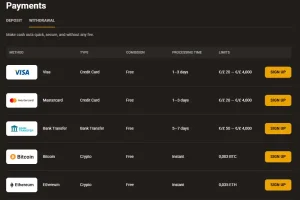
An offshore casino’s cashier may offer credit cards, e-wallets, bank transfers or cryptocurrency. Some use alternative payment processors, so the name shown during checkout may differ from the casino brand. That affects how a transaction is routed; it does not establish who regulates the gambling service.
A payment option is not a promise about cashing out. A casino may accept a deposit through a particular card, wallet or crypto asset without offering withdrawals by the same route. Before sending money, check the withdrawal methods and any conditions in the cashier and account terms. Availability can depend on the operator and its processor.
Cryptocurrency has a specific connection to the UK credit-card gambling ban: paying with crypto can bypass that restriction on credit-card-funded gambling. That describes a payment route, not a protective feature. Crypto does not make an account safer, give you a UK complaints route or guarantee that a withdrawal will be processed. The relevant regulatory question is about the operator and the market it serves, not whether the deposit is made in coins or pounds.
Some offshore payment menus may also mention deposits charged to a mobile phone bill or taken from a prepaid balance. A specialist review has reported these options, but they should not be treated as a standard feature: check whether the current operator actually offers them and what its terms say.
Payment Route Check
- Confirm if the deposit method also supports withdrawals
- Identify what information the payment provider requires
- Review the casino’s terms for clear processing explanations
- Verify the operator’s regulatory status separately from the payment technology
Compare payment routes by the criteria that matter to you: whether the method supports withdrawals, what information the provider requires, and whether the casino’s terms clearly explain processing. A familiar logo in the deposit window answers only one question. It does not settle how a later payout will work.
If you are asking whether crypto casinos are regulated, the currency alone gives no answer. A crypto-funded account may be offered by an operator under a licence from outside the UK, and the payment technology does not change that licence’s scope. Treat the casino’s stated payment methods and its regulatory status as separate checks. A deposit route is not a regulator.
What the UK Gambling Commission’s Licence Covers
A UK Gambling Commission licence is the relevant operating licence for an online casino serving customers in Great Britain. The operator’s headquarters do not change that requirement: a company based overseas still needs a UKGC licence if it offers gambling to people in Great Britain.
Non-UK Registered Casinos: Licences and Risks
This makes the licence a question of which market the operator serves, not simply where its business is registered. A casino may hold permission from another jurisdiction, but that authorisation is not a substitute for a UKGC licence when the operator serves Great Britain. The two licences come from different authorities and apply within different regulatory systems.
For you, the useful distinction is between a casino authorised to serve the British market and one that holds only an overseas licence. The phrase “UK Gambling Commission regulated” refers to oversight by the Commission; it should not be used as a loose synonym for having any gambling licence. A foreign authorisation does not, by itself, place an operator under UKGC oversight.
The Commission’s licence therefore identifies the regulator responsible for an operator serving Great Britain. It is not a general certification that follows a company wherever it operates, nor does a licence issued elsewhere acquire UK status because the site accepts a particular payment method or offers familiar games. The market served is the deciding criterion.
Non-UKGC Licensed Casinos: Licences and Risks
When comparing casinos, keep the regulator and the customer market in separate columns. An overseas base and a UKGC licence can coexist; an overseas licence alone does not meet the requirement for serving customers in Great Britain. That distinction is more useful than the operator’s branding or the country shown in its company details. A licence name matters only in relation to the authority that issued it and the market the operator serves.
How to Check an Online Casino Licence and Its Limits
To check an online casino licence, start with the regulator’s public register rather than relying on a badge or licence number displayed on the casino’s website. For a site claiming an Anjouan casino licence, find the entry in the Anjouan register and compare the registered company name with the company named in the casino’s terms. Check that the entry is current and note its expiry date. A mismatch, missing entry or expired licence is a reason not to treat the claim as verified.
For a casino claiming UKGC approval, use the UK Gambling Commission’s public register and check that the operator’s name and licence status match the business serving you. The regulator and the scope of the licence matter: an entry from another authority does not become a UKGC licence because the casino accepts British customers or uses UK-facing branding.
A licence check has limits. Anjouan’s authority does not take up player complaints, settle them between you and the casino, or issue decisions on individual disputes. The casino is required under that framework to respond to a complaint within 30 calendar days, but that obligation is not the same as an independent adjudicator. An Anjouan-licensed operator also does not give you access to the UKGC complaint process or an independent dispute service equivalent to UKGC-approved ADR.
Keep copies of the licence details, the operator’s terms and your correspondence. If a problem arises, follow the casino’s own complaints procedure and record when you submitted your complaint. A register entry can help establish what licence is claimed; it cannot guarantee how a dispute will be resolved. That distinction matters.
Material created by the team SlotLair